The popularity of football teams and their shirts has long come down to two things. Primarily, it has, of course, always been a team’s history of success and current heights. In the last couple of decades, the sale of shirts has become more influenced by a kit’s aesthetic appeal. Take the Nigeria 2018 World Cup kit, which became such a hyped-up streetwear drop that it racked up an estimated 3 million pre-orders before it even hit shelves. Undoubtedly bought by many who had ever set foot in Nigeria, its design was so popular that it transcended football fandom to become more akin to a collectable trainer release. Shops rapidly sold out, and knock-off versions began appearing in the street sellers’ spread all over the place.
While not a feature in the UK, in many countries, the selection of football shirts displayed by street merchants is a more organic reflection of the popularity of players and clubs. At the very least, it represents those deemed the most likely to sell to the average passerby. In Spain, for the last couple of years, this selection has been largely unchanged from the following: The neon pink of Inter Miami emblazoned with its widely-worshipped Lionel Messi, the fluorescent yellow of Cristiano Ronaldo’s Al-Nassr, Barcelona kits sporting the name of the prodigal Lamine Yamal, and, of course, the bright white of Real Madrid and its numerous Galacticos.
You’ll often also see the shirts of Premier League giants, Paris Saint-Germain, and maybe a couple of Italian teams. Of late, a new kit has joined this popular patchwork, one out of place and far less distinguishable than the others, but one that is emerging thanks to its sociopolitical standing and associated values.
Enter Rayo Vallecano
The red-sashed shirt of Rayo Vallecano. Madrid’s third team does not find itself on display in the Spanish streets courtesy of any idolised poster boy. Certainly not one that you’ll see on bus stops and billboards staring at you seductively in promotion of a new perfume, flaunting a six-pack in a pair of Calvin Klein boxers, nor, in young Lamine’s case, sporting a huge grin while holding a box of Nesquik chocolate powder. Having not won a major trophy in its 101-year history, it also certainly isn’t down to a storied history of triumphs and titles. Instead, Rayo Vallecano shirts have appeared largely due to what the club has become to represent off the football pitch.
This flourishing club identity, closely following a path paved by Germany’s cult team FC St Pauli, has been gradually breaking free from the shadow long cast by Atlético Madrid and Real Madrid in the Spanish capital. Likely stoked by an urge to counter the growing right-wing influence across Europe, the red stripe of Rayo can be seen more and more on the streets of Spain, far from the small working-class neighbourhood of Vallecas.
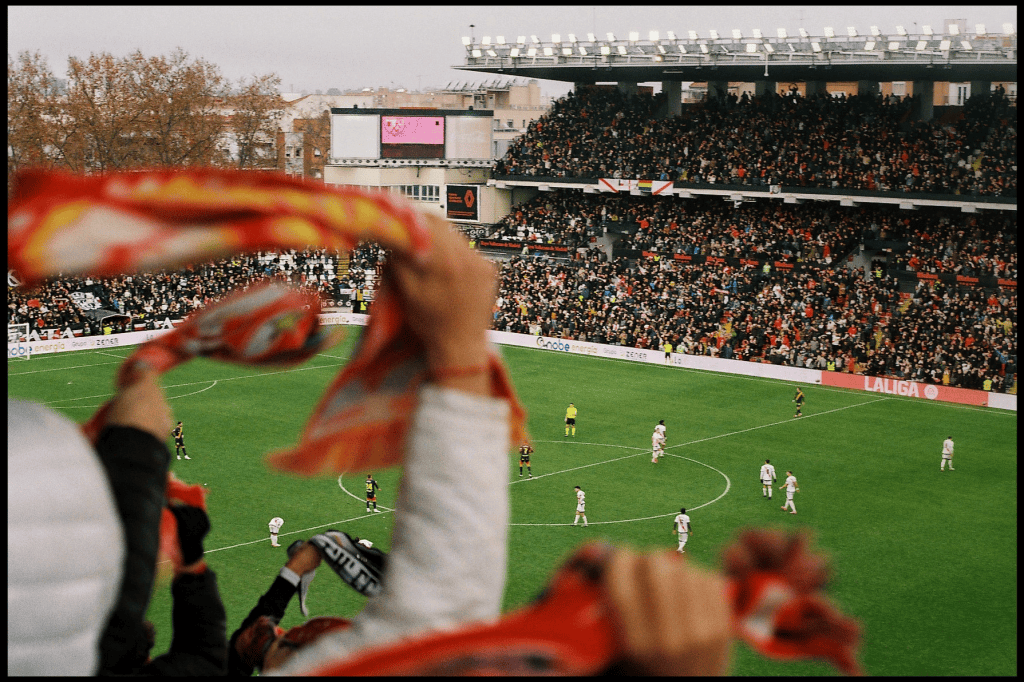
Already amplified by its recent underdog success in La Liga, the club’s exposure is soon to be bolstered further by playing on an international stage. On Thursday, Rayo Vallecano takes on Macedonian champions KF Shkëndija for its first European match in 24 years. The club’s last and only competitive run in Europe came in the 2000/01 UEFA Cup after it was admitted thanks to UEFA’s Fair Play Qualification. This time around, Rayo qualified after finishing eighth in Spain’s top flight last season. A finish they achieved despite competing with the lowest income in the league, a budget equivalent to less than one per cent of that of Real Madrid.
The disparity between these two clubs, while patently clear, is also almost unfathomable. The recently revamped Bernabéu, long one of the most premium homes of football in Europe, now features a retractable roof and a sliding pitch that disappears underground to make way for other events such as November’s NFL clash. To watch Rayo Vallecano play, you can’t even buy tickets online; instead, you have to head to the stadium and queue two days before kick-off.
The stadium is dilapidated to say the least. Financially, the club is distinctly undernourished, with a home that doesn’t even attempt to hide its countless defects. An assemblage of inadequacies recently included a broken VAR system that cost Rayo a valuable victory over giants Barcelona. By contrast, the stadium belonging to last season’s eighth-place finishers in the Premier League is the award-winning £93 American Express Stadium of Brighton & Hove
Albion.
While financially, La Liga and the Premier League may be in entirely different brackets, it only goes to accentuate the fact that Rayo Vallecano are punching well above their weight like nobody else in the top leagues of modern football.
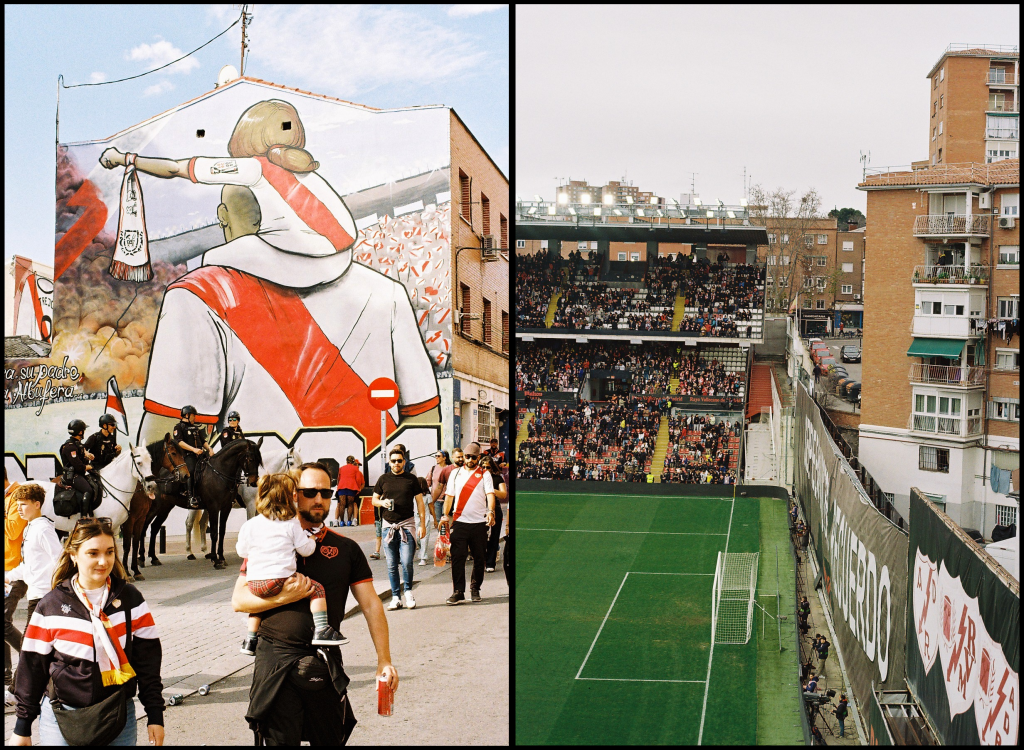
For the reasons above and more, the Estadio de Vallecas is currently at the centre of civil war, both rocking and igniting the club. With a total capacity for fewer than 15,000 spectators, it sits in the heart of the neighbourhood with small high-rise flats overlooking one side, including one residence which only two seasons ago was paid a visit by a ball Real Madrid’s Federico Valverde had half-volleyed over the crossbar.
It’s outdated, fatigued, and decrepit, and yet cherished. Rayo owner and president Raúl Martín Presa wants a government-funded new ground. Coach Iñigo Pérez and seemingly the entire fanbase unequivocally do not. The stadium lies at the heart of a close-knit, football-obsessed community with proud roots in activism who pride themselves on being custodians and not consumers. The club is not just the nucleus of Vallecas, it is also the community’s only voice strong enough to project its views further than the neighbourhood itself.
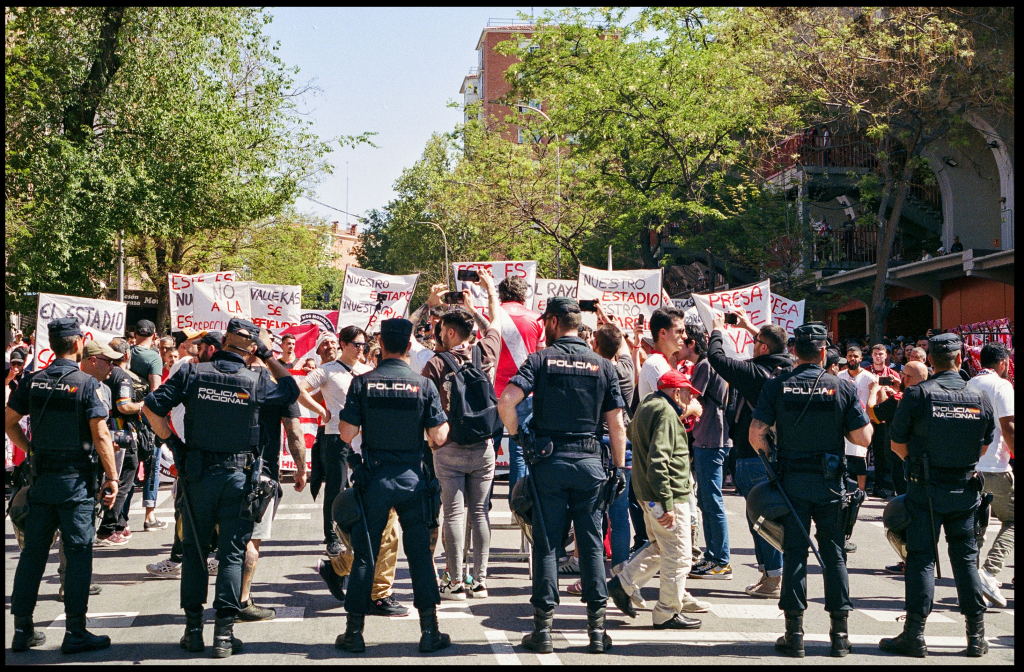
There are several things you can bank on experiencing when watching a Rayo Vallecano match. The ultras, Los Bukañeros, fly flags and banners including the old anti-Franco republican colours of red, yellow and purple, black banners with the words “Working Class” (in English), and sometimes the face of Cuban revolutionary Che Guevara. The words “The Independent People’s Republic of Vallekas” can be seen on t-shirts and other paraphernalia, while left-wing slogans appear on graffiti or on stickers.
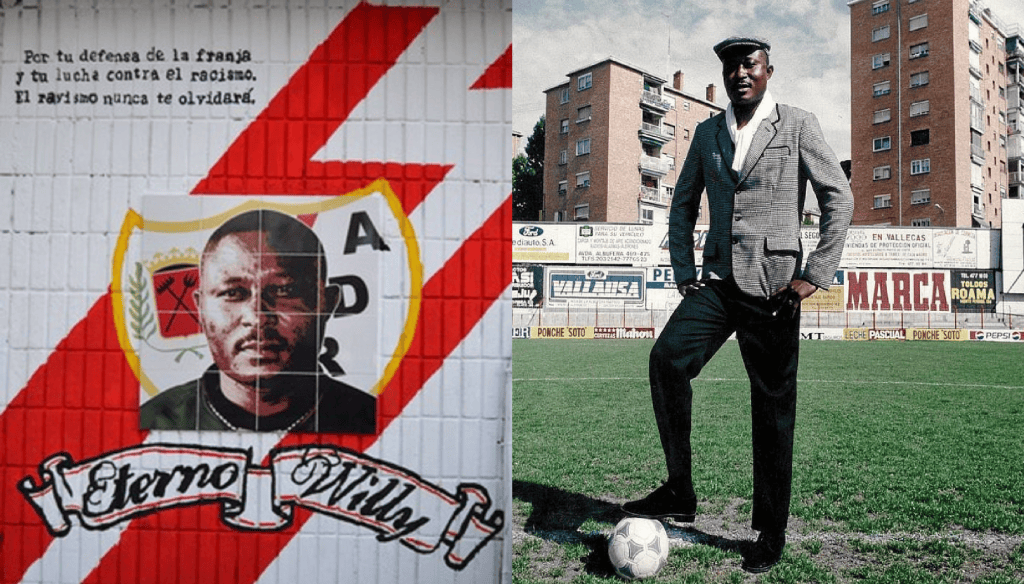
There’s also a chant of “Willy” at every game in remembrance of Wilfred Agbonavbare – the team’s Nigerian goalkeeper from 1990–1996 who endured consistent racism during his spell in La Liga, and died of cancer in 2015. Agbonavbare became a symbol of Rayo’s resilience and inclusivity. After his passing, the club named an entrance after him and paid homage with a permanent mosaic tribute reading “For your defence of the sash and your fight against racism, we will never forget you.”
That same year, Rayo Vallecano launched an away shirt with its traditional single diagonal stripe instead made up of rainbow colours for the 2015-2016 season to highlight support for social causes. The following campaign, when the club signed Ukrainian Roman Zozulya on loan from fellow Spanish club Real Betis in January of 2017, fans gathered in protest over the new arrival’s alleged neo-Nazi links and his contract was soon terminated without making a single appearance for the club.
Then there is Carmen Martínez Ayuso, an 85-year-old local facing eviction due to her home being used as collateral by her debt-ridden son. The club stepped in, committed to paying her rent and launched a fundraising account to collect donations to help her. The account surpassed €20,000.
These actions, a source of pride among Vallekanos, are now part of a club identity radiating outward, striking a chord with fans far from the working-class neighbourhood in the south of Madrid, much like FC St. Pauli’s pull from a gritty district of Hamburg. The iconic Jolly Roger emblem of the German club may soon have a counterculture accomplice in the wider footballing landscape: the thunderbolt of Rayo Vallecano.