This week I finally attended a Bon Iver concert at the Wizink Center in Madrid. A generous friend and great admirer of Justin Vernon had bought me a ticket as a birthday present in 2020 but it had been repeatedly postponed due to the Covid-19 pandemic.
I’ll start by saying that when receiving the ticket I was not a follower of Bon Iver and knew little of their musical pursuits, but being a resident of Madrid I was familiar with the WiZink Center and knew that only the most revered of artists perform there. The Coronavirus-induced delay had provided me with ample time to become acquainted with Bon Iver’s music, and I devoted a good amount of time and attention to listening to their first 3 studio albums in an attempt to ensure that I would not feel like a lost lamb in a crowd of zealots when the concert came.
I had a strong feeling this was a band with a particularly loyal following of fans who get it so I was keen to fathom the hysteria and perhaps even ascertain some understanding of the emotions behind their work. At the very least, I might vicariously taste the Wisconsin winter through lines like “the end of a bloodline, the moon is a cold light.”
Having worked with hallowed artists like Taylor Swift, Richard Reed Parry, and Kanye West, it was clear that Bon Iver’s lead singer Justin Vernon had cemented a significant reputation in the music industry and was perhaps not the cryptic hermit that Bon Iver’s Wikipedia introduction suggests (I’ll come to that shortly). Rather, he was a Grammy Award-winning genius of sorts and I felt obliged to carry out some light ‘research’ by reading the odd article and listening to podcasts including an episode of James Acaster’s Perfect Sounds.
In this episode, Acaster and guest Nish Kumar spotlight Bon Iver’s 22, A Million album and discuss an anecdote about the track 22 (OVER S∞∞N). To contrive this particular medley, Acaster explains, the band reportedly recorded over an old cassette tape that they had removed, scrunched up, and scribbled on in order to implement random imperfections. While you have to appreciate unorthodox experimentation of this kind, there was certainly a skeptical voice in my head querying whether this was just a gimmick. Regardless of its verisimilitude, however, any artist with such peculiarities piques inevitable interest and I was excited to see what a band with such maverick methods might be like at a live performance.
I had also now become familiar with the story of Justin Vernon’s self-exile to western Wisconsin where he spent months putting together his first album For Emma, Forever Ago isolated in a cabin. This piece of information, so hastily introduced on the band’s Wikipedia page, appears to have become such a prevailing detail in Bon Iver’s identity and again I was forced to quash the cynical alarm bells in my mind. I’d soon learn that this was not a histrionic PR stunt stoking the fire of artistic eccentricity; it was rather a soul-searching emotional pilgrimage where memories and sorrow were to be alloyed into an effervescent catalyst for poetic inspiration.
Anyway, back to the gig. We made our way to somewhere relatively near the front where my most fanatical friend had pinned down space for us all to enjoy with a good view not far from the messiah himself. Pushing past people is never easy nor enjoyable at gigs, festivals, or anywhere else of that ilk but these fervid Bon Iver fans were particularly displeased and held their ground like the Spartans at Thermopylae. Who knew so many Spaniards liked Bon Iver when I can barely understand the lyrics as a native speaker and ex-English language teacher? That said, I sometimes struggle to discern Buena Vista Social Club’s lyrics and I enjoy what they do
immensely, so I suppose linguistic comprehension doesn’t really hinder musical gratification.
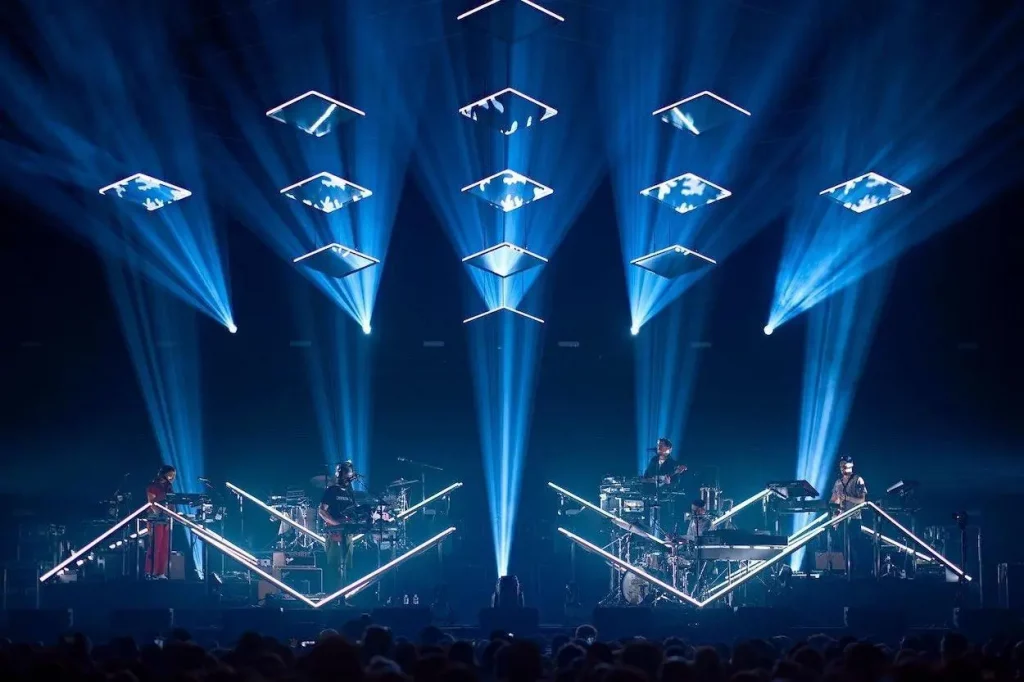
As the band members took to the stage each was positioned on their own individual geometrically illuminated dais. It was a striking setup and you already knew this would be no humdrum experience. Almost immediately, a strong smell of weed filled the air. Fair enough, if you’re into sparking up and enjoying poignant, slightly depressing music, it probably doesn’t get much better than this setup.
The geometric boxes were positioned below 20 or so rising and falling square plates which levitated above the central stage, moving and changing colour with every song. Another scintillating spectacle. I’d heard that there was more to Bon Iver’s performances than harrowing harmonies and this was quickly validated.
Several friends and acquaintances in Madrid had described Bon Iver’s songs as mind-blowing live experiences and what followed was certainly special. Vernon’s voice sent lyrics ricocheting around my chest and felt akin to the first time I heard the enchanting sounds of Radiohead or the impassioned verses of the Lumineers. (While I may be doing Bon Iver a huge injustice here by daring to compare a band so prized for being so deeply unique and wildly experimental but hey ho, these are two musical giants, and that is nothing but flattery in my book.)
Let me say now, it was a breathtaking performance. Seeing Justin and company produce hits like Skinny Love, Blood Bank, and Holocene WAS magnificent. This was no ordinary experience of live music but I did find myself leaving immensely confused. One minute I was enjoying the devastating beauty of Vernon’s emotional poetry to next be knocked back by the cluster bomb of sounds in the form of songs like 10 dEAThbREast.
Between each sorrowful symphony, there seemed to always be an Aphex Twin-like track whereby Justin Vernon distorted his voice in various ways and looped the results, playing them side by side or on top of each other to create a melee of melodies. I say melody because alone each vocal would have undoubted charm but in this moment it felt like somebody had left too many active tabs open on a laptop. For all I knew, I was hearing an ancient Nordic folk song played backwards, cut up, and pieced back together randomly. I felt bad for my Spanish friend who had earlier proclaimed “I don’t understand nothing”, to which I replied, “Don’t worry mate, me neither.”
I enjoyed the autotuning in many Bon Iver songs much more than I expected to but many of these moments still left me baffled. I seemed to be completely alone in this sentiment, however, as reciprocally the crowd grew more and more bedazzled. The possessed Wisconsinite in front of me was most definitely enjoying Vernon’s voice simultaneously echoing through various dimensions, but then again he’s experienced the bleak Midwestern winter so may have much more to relate to with Vernon’s poetry than a Brighton-born Englishman like me.
Everybody around me, many, if not mostly Spanish, responded with such enthusiastic applause that it made me feel like I was experiencing it all from behind a warped window. Were they cheering just to cheer? I heard shouts of “Hell yeah!” and “Vengaaa!”. Maybe my thoughts are just those of somebody who enjoys music in its many forms but feels discombobulated when noisy experimentation goes too far. Though I’m sure when John Lennon started singing about being a walrus I would have been equally as confused.
“I’m going to leave you with this concept”, Justin concludes his encore performance before playing a song with such clear pronunciation it felt for a moment the mist had cleared, and the enigma code had been broken, but no, this was a concept song pushing the boundaries from experimental back around to normal again. “Spread the love,” he then encourages before leaving the stage to delirium. He’s humble, emotionally astute, and wonderfully compassionate in addition to being a talented wordsmith, and I even feel a little guilty for being confused.
There is most certainly admiration for Vernon’s resolve to not fall into a category of American indie-folk that has seen so many bands reap the rewards of catchy, singable songs. I certainly wouldn’t want him to stop doing what he does, but I couldn’t help but feel that sometimes the scrapyard sounds felt overwhelmingly and unnecessarily chaotic, ruining the beautifully consoling harmonies of Bon Iver’s pensive ballads, like taking an ethereal watercolour painting to a pestle and mortar in the name of modern art.
Bon Iver’s work is astounding, and this was unquestionably an exceptional live spectacle. Yet, still, I can’t help but feel dazed and discomforted when the beautifully crafted solace sometimes so effectively glimpsed in their work is all too often desecrated by incomprehensible self-sabotage. Is that the point?